

Indiana’s New Map: Will It Pass, and Is It Built for a Blue Wave?
A closer look at the Hoosier State's newly proposed congressional districts

When Texas passed its new congressional map earlier this year, it set off a round of redistricting drama that engulfed the nation. Nowhere has this been more pronounced than in Indiana, where lawmakers have faced bomb threats and swatting amidst rising tensions over the state’s district lines.
After months of back-and-forth, the battle for the state’s nine House seats is finally seeing some movement. The Indiana House passed a map proposal this week, and the state Senate will convene on Monday to consider the bill.
How likely is the Senate to go ahead?
Even though 40 out of its 50 members are Republicans, the Indiana Senate is split on redistricting. According to Nathaniel Rakich’s running tally, 14 Republicans have signaled their opposition to a new map, equaling the number in support. Another dozen Republicans are undeclared. If all 10 Democrats in the Senate oppose the new map, the GOP cannot afford to lose more than one of its undeclared members.
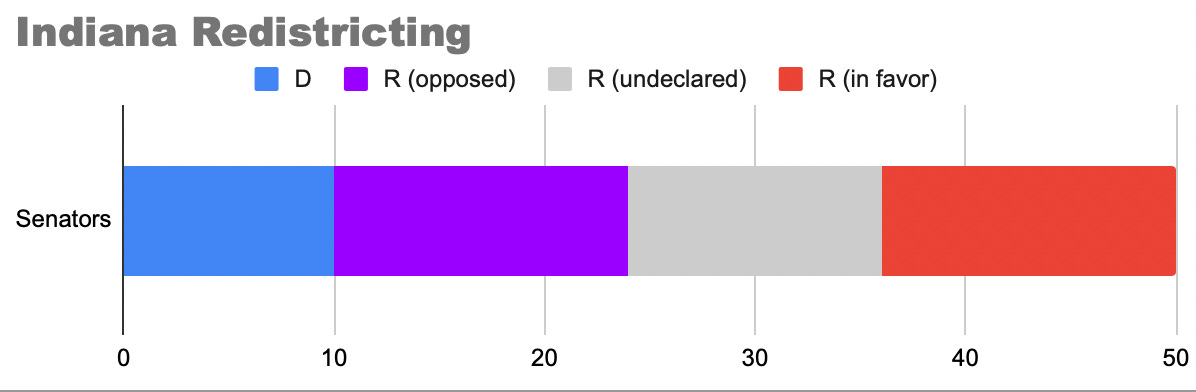
These are not easy circumstances to pass a new map under. On Kalshi, a prediction market, traders give Indiana just 42% odds of redistricting.
Does the map hold up?
If successful, Indiana’s redraw will likely force both of the state’s Democratic House incumbents out of office. André Carson, who represents the 7th district, looks to be the more doomed of the two. While his current district contains a D+40 seat encompassing most of Indianapolis, the proposed map further cracks the city apart, swinging the 7th over 60 points to the right.
DRA file for Indiana map used in this analysis.
The first district is more complicated. Under the newly proposed boundaries, it would have voted 10.5% to the right of the US in 2024. This isn’t a totally safe margin: Democrats won the House vote by over 7% in Trump’s first midterm in 2018, and incumbent Frank Mrvan outperformed expectations in the 2020 and 2024 elections. Whenever new maps are drawn, it’s always important to stress test them, and a Democratic-leaning environment next year could see Mrvan hold on.
Off-cycle elections present another challenge. While Indiana Republicans were careful not to create any new swing districts while drafting their new map, that logic mainly applies to high-profile national races like the midterms. Special elections, on the other hand, have increasingly favored Democrats in recent years, regularly resulting in double-digit overperformances under lower turnout.
Why does this matter? To draw out IN-01 and IN-07, Indiana’s other districts have to shift left by an average of 9%. Nearly every district in the resulting map would be Trump +20 or less. This doesn’t mean the new map is a dummymander, but it could see the occasional competitive race if special elections are called.
What a new map means for 2026
The GOP enters the 2026 midterms in a difficult position. In 2024, it won 220 House seats to Democrats’ 215. Because presidential parties tend to get walloped during midterms, such a narrow majority could easily be wiped out in a Democratic-leaning 2026 environment. Generic ballot polls and recent elections point to exactly that, further motivating Republicans to make significant gains via redistricting.
With blue states pushing maps of their own to draw out Republican incumbents, both sides are at risk of losing substantial numbers of seats. In fact, the redistricting wars could plausibly end in a tie. Indiana would be key for the GOP to avoid a stalemate, making the Senate’s upcoming decision all the more important.